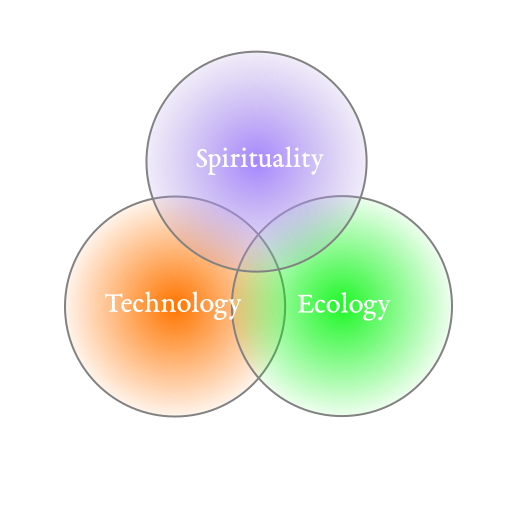
What do we mean by a living village or neighborhood? It means that the place itself is alive. Specifically, the place itself is living in the sense that it:
We can incorporate ecosystems directly into our local infrastructure.
The Green Center is a non-profit educational institute that evolved from The New Alchemy Institute. With the help of a small board of directors and volunteers, former New Alchemists Hilda Maingay and Earle Barnhart continue NAI’s mission to “create ecologically-derived human support systems” which include renewable energy, agriculture, aquaculture, housing, and landscapes.
These folks are building on the work of John Todd, et. al.
Todd and his colleagues were some of the first people to actually create miniature ecosystems, largely self-perpetuating, which applied ecological principles to address human needs. Todd's approach is one of biomimicry, in which a complex natural ecosystem such as a marsh is studied, recreated and adapted.
~ John Todd, Ecological design :: Wikipedia
They have created an awesome vision of what they call Greenway, which essentially extends the concept of bioshelters to whole neighborhoods:
Greenway is a vision of an ecological neighborhood, where basic needs – food, water, shelter, transport, communications – are provided in ecologically sustainable ways with renewable energy. It’s a network of homes, greenhouses, garden, and businesses, connected by sheltered corridors. Housing is integrated with agriculture. Biology is integrated with technology. People are integrated with the cycles of the Earth.
~ Greenway :: The Green Center
Here is a sketch of a crude and incomplete schematic for a
ecosystem of sorts for a regenerative eco-village or neighborhood:
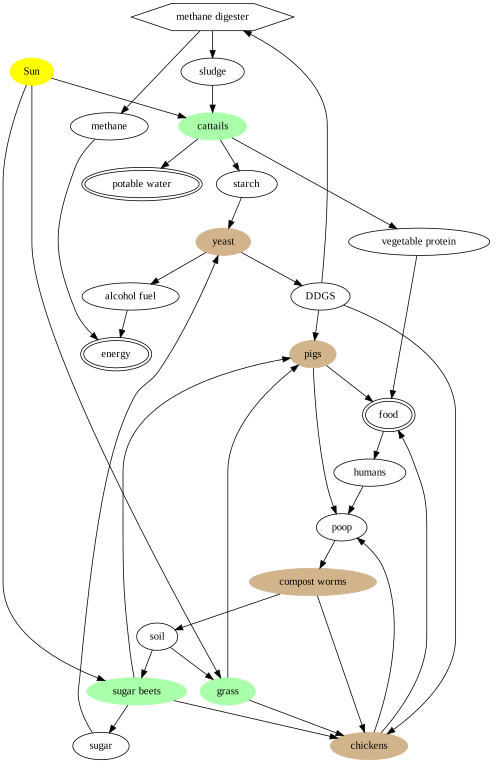
I've left out most of the food production system because we can "plug in" the Grow BioIntensive system (which takes care of producing a complete diet while increasing the fertility and volume of the soil.) To that base we add systems for developing alcohol and methane as fuels and industrial products, and waste processing to "close the loop" and complete the metabolism of the village.
Plants:
Animals:
The system is solar powered and carbon-negative and it generates wealth exponentially. Also it's fun and easy.
This is based on David Blume's system from Whiskey Hill Farm, where he ferments alcohol; sends the byproducts to a methane digestor; uses the methane for power and the byproducts as inputs to a cattail marsh; the cattails clean the water and produce starchy tubers (for more alcohol, better than corn for that by a lot) and; the greens are treated with alcohol to extract veg protein. It's a circular system that cleans water as it produces several kinds of valuable products. Farmer Dave is a genius.
I threw in pigs and chickens because I like them, but you could use lots of different "macro" livestock (as contrasted with "micro" livestock: soil biota, yeast, etc., and "mini" livestock like the compost worms.)
Obviously, I've left out many details. For instance, alcohol is used to extract the veg protein from the cattail greens, and energy would be used in many places.
Christopher Alexander meant it quite literally, that we could create living buildings and towns. In his magnum opus "Nature of Order" he identifies the task of architecture as nothing less than bringing being into physical existence. In other words, he believed buildings and neighborhoods can (and should) be more or less alive. He developed an experimental protocol...
Another thing that was happening around this time (late 70s early 80s), my colleagues and I began toughening up our ability to discriminate empirically between living structure and not living structure. ... If you want to say this one has life, this one has less life, how do you say that with any degree of empirical certainty? Can it, in fact, be made a relatively objective matter which people can agree about if they perform the same experiments.
Indeed, we did find such experimental techniques.
The essence of the experiments is that you take the two things you are trying to compare and ask, for each one, is my wholeness increasing in the presence of this object? How about in the presence of this one? Is it increasing more or less? You might say this is a strange question ... it turns out that there is quite a striking statistical agreement, 80-90%, very strong, as strong a level of agreement as one gets in any experiments in social science.
Do you feel more whole? Do you feel more alive in the presence of this thing? Do you feel that this one is more of a picture of your own true self than this thing you know whatever? It is always looking at two entities of some kind and comparing them as to which one has more life.
we can characterize not merely the structure of things which are well-designed, but we can characterize the path that is capable of leading to a good structure. In effect, we can specify the difference between a good path and a bad path, or between a good process and a bad process.
It must be our aim to make the world's environment a living structure, within one or two generations. How, realistically, can be that be done?
When I first constructed the pattern language, it was based on certain generative schemes that exist in traditional cultures. These generative schemes are sets of instructions which, carried out sequentially, will allow a person or a group of people to create a coherent artifact, beautifully and simply.
What I am proposing here is ... a view of programming as the natural genetic infrastructure of a living world which you/we are capable of creating, managing, making available, and which could then have the result that a living structure in our towns, houses, work places, cities, becomes an attainable thing. That would be remarkable. It would turn the world around, and make living structure the norm once again, throughout society, and make the world worth living in again.
~ Christopher Alexander, "The Origins of Pattern Theory, the Future of the Theory, And the Generation of a Living World", Keynote Speech to the 1996 OOPSLA (Object-Oriented Programs, Systems, Languages and Applications) Convention (video)
Alexander identified fifteen "structure-preserving transformations", geometric patterns or motifs which he believed would, when applied to the holistic in situ development of a site or building, lead to increasing the livingness of the place.
In lieu of writing them up myself here are some links to other folks' write-ups:
The idea is that you can use these patterns to help wholesome living systems emerge from inanimate constructions, from the “Unmanifest Ground of Being”. Alexander's description of being being immanent in space can be seen to correspond to the "Godhead or Ground, which is the unmanifested principle of all manifestation" of the Perennial Philosophy.
Friends and followers of Christopher Alexander have created a website called Building Living Neighborhoods:
Our goal is to help everyone make our neighborhoods places of belonging, places of health and well-being, and places where people will want to live and work. This has become possible through the use of Generative Codes, Christopher Alexander's latest work in the effort to make possible conception and construction of living, beautiful communities that have real guts -- not the sugary sweetness of pseudo-traditional architecture.
~ Building Living Neighborhoods
Low embodied energy, natural "renewable" building materials, e.g. paper and silica tubes, mycelium insulation.
Trees and plants as living structural elements. How far could we take it?
Combining the integrated ecosystems and infrastructure of Todd, et. al. and the bio-generative shapes and forms of Alexander we can walk the land and evoke a living village or neighborhood ourselves, with emergent life that supports us in ours.